IGEL Blog

From .NEXT to Now: What Nutanix and IGEL Are Solving in Modern EUC
More than half of organizations (54%) are now operating in hybrid cloud environments, yet most are still managing endpoints like it’s 2015.
That mismatch is why complexity has crept into most mid-enterprise organizations. IT teams are managing modern infrastructure with outdated endpoint assumptions, leading to higher support costs, inconsistent security posture, and slower response during outages. Applications are centralized. Infrastructure is flexible. But endpoints remain inconsistent, vulnerable, and expensive to manage. The result is friction across security, performance, and operations that no single tool can fix.
This is the gap Nutanix and IGEL are addressing together.
Not by adding more layers, but by reshaping how the system is supposed to work.
A Simpler Model for a More Complex World
The traditional endpoint was built for a world where everything lived locally, but that world is gone.
Today’s desktops are delivered from hybrid multicloud platforms, and the endpoint’s role has shifted from “do the work” to “access the work.” The Nutanix and IGEL approach leans into that shift.
Nutanix centralizes applications and desktops across cloud and datacenter environments, using hyper-converged infrastructure to deliver predictable performance, simplified operations, and linear scalability for EUC workloads. IGEL standardizes how users securely access those resources at the endpoint.
Instead of trying to harden a complex device, the model simplifies it.
Windows workloads run where they can be controlled and secured. The endpoint becomes a trusted, policy-driven access layer. In practice, that means a clinician, call center agent, developer, or financial analyst can log into any device and receive a consistent, secure workspace without IT needing to reconfigure or remediate the endpoint.
This is where the IGEL Adaptive Secure Endpoint Platform™ becomes practical.
The execution plane defines a known, controlled runtime
The control plane, through Universal Management Suite (UMS), enforces policy at scale
The data plane, via the IGEL App Portal, ensures only validated applications are delivered
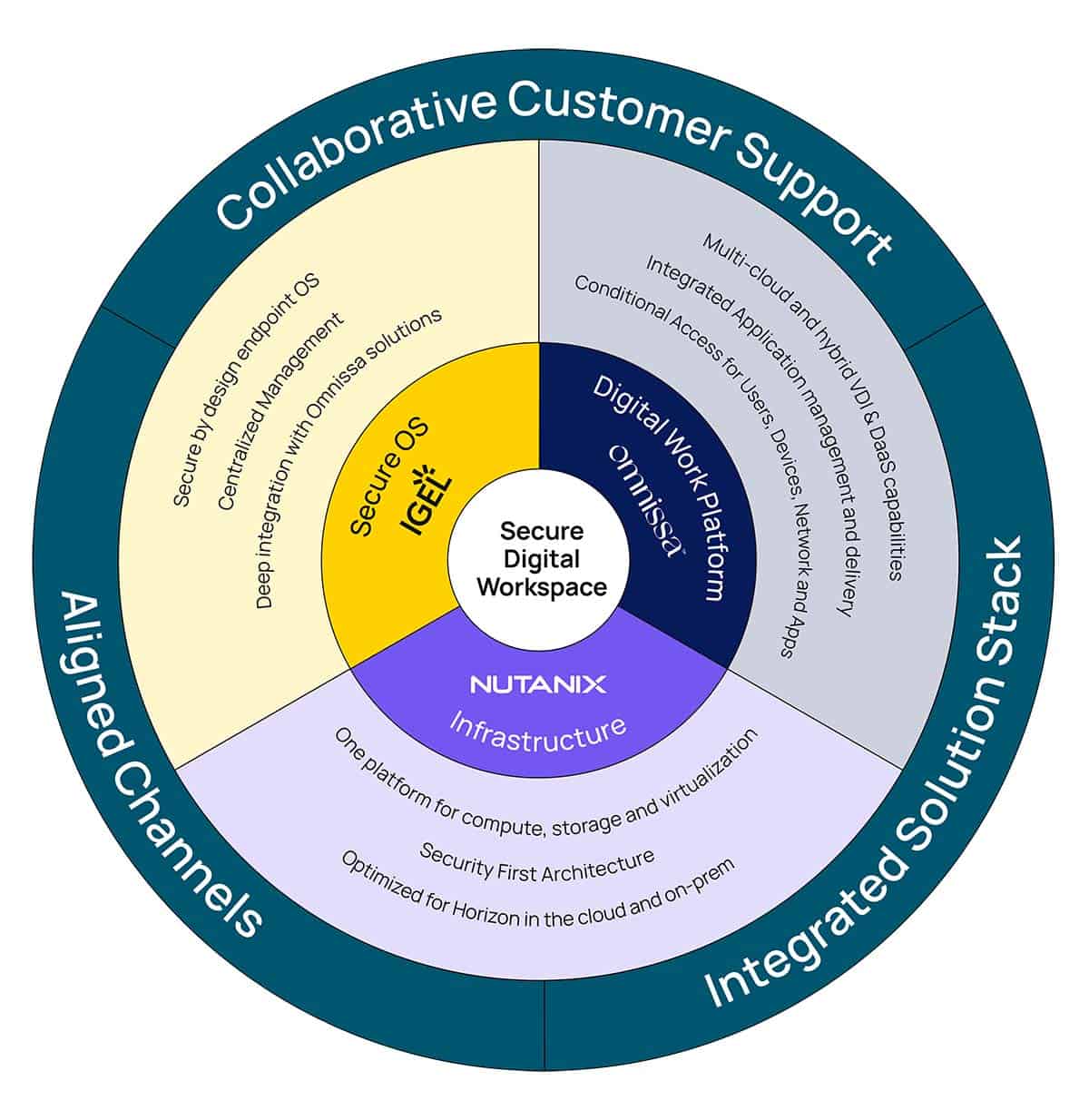
Together, these three planes separate execution, control, and delivery, allowing IT teams to manage thousands of endpoints with consistent policy instead of device-by-device intervention. Nutanix feeds this system with centralized, scalable infrastructure, while IGEL ensures every endpoint interacts with it in a consistent, governed way. Below is a visual representation of how Nutanix, Omnissa, and IGEL work together to provide greater value together.
Security That Starts Before the Session
Most security models begin with login. The problem is that risk often begins earlier.
The IGEL Preventative Security Model™ ensures the endpoint starts from a trusted state. No local data. Minimal attack surface. No persistence for threats.
Nutanix extends that trust into the infrastructure layer with identity controls, role-based access, and micro-segmentation.
Together, this creates a clean security posture:
- The endpoint is trusted by design
- The infrastructure is segmented and policy-driven
- Access happens without exposing unnecessary risk, with no data stored locally on the endpoint and policies enforced across both the device and infrastructure layers
It is a shift away from detection-heavy strategies toward preventative architecture.
Nutanix and IGEL at Now & Next Miami
In March, Nutanix and IGEL joined forces in Miami at Now & Next 2026 to show how this joint model works in practice. IGEL also awarded Nutanix the IGEL Ready Global Partner of the Year 2026 Award for their strong ecosystem leadership, technical integrations, growth, application performance, and cybersecurity excellence.
Learn more about the Nutanix and IGEL partnership in our Now & Next blog post.
A More Complete EUC Model, Built for How Work Actually Happens
Nutanix and IGEL are not creating something new. They are completing the end-to-end architecture of what already exists, enabling organizations to do it better.
Infrastructure is centralized. Endpoints are controlled. Policy connects the two.
The result is a system where complexity is contained, and security, performance, and continuity work together. IT teams spend less time maintaining endpoints and more time delivering reliable access to the business.
Nutanix defines where work happens.
IGEL defines how it is accessed.
Together, they make the environment simpler to manage and more resilient when it matters most.
Check out the IGEL OS platform and the IGEL Preventative Security Model for yourself!
Download a trial version today.
Posted in Cybersecurity, Now & Next
Related Posts