IGEL Blog
Now & Next 2026: What You Saw and What It Means
CIOs did not leave Now & Next 2026 asking whether changes would happen in their endpoint environment. They already know it will.
What changed is how they plan to operate to ensure that their environment can handle change.
Instead of a defensive posture and a recovery system that waits for systems to come back online, Now & Next attendees saw something much greater.
A model that treats the endpoint as an active control point for access, security, and continuity while conditions are still changing.
That is what IT leaders are accomplishing with The Adaptive Secure Endpoint Platform™. It’s a different expectation of what the endpoint must do. It must interpret context, enforce policy, and preserve access without relying on a single path or a single environment.
Adaptive access is no longer optional
One of the key announcements from the event came with IGEL Contextual Access.
For years, organizations tried to standardize the endpoint experience. One desktop, one policy set, one way to access applications. That model often breaks down the moment users move between roles, locations, or risk conditions.
Contextual Access changes the starting point. It allows the endpoint to adjust the experience in real time based on who the user is, what device they are on, and what conditions surround that session.
A clinician logging into a shared workstation, a contractor connecting remotely, and an administrator accessing sensitive systems no longer inherit the same environment. The endpoint enforces different outcomes by design. The Adaptive Secure Desktop becomes a living interface shaped by policy rather than a static delivery mechanism.
Continuity moves to the moment of disruption
At Now & Next, business continuity and disaster recovery was a big topic of conversation.
Historically, continuity planning focused on recovery timelines. Systems fail, teams respond, and access returns after remediation. That sequence assumes there is time to recover.
IGEL BC&DR Emergency Management Mode introduces the ability to shift endpoints into a controlled, secure state immediately, without waiting for a full incident response cycle. An administrator can move devices away from a compromised local environment and into a trusted execution path in seconds.
What matters is not the reboot itself. What matters is that access does not stop.
Applications continue through alternate delivery paths such as cloud desktops or hosted environments. The endpoint changes how work is delivered, but it does not interrupt the work itself.
This is where continuity becomes practical. It is no longer defined by how quickly systems recover. It is defined by how well access persists while everything else is still in flux. See the announcement.
The endpoint becomes the meeting point of ecosystems
Another pattern that stood out at the event is how much coordination now happens at the endpoint.
Announcements like the Microsoft reference architectures and the IGEL for Windows app show how cloud desktops are becoming a primary delivery path. At the same time, integrations with partners such as Island, Netskope and Palo Alto Networks bring network and browser security directly onto the device.
Identity, network policy, application delivery, and device posture all converge at the endpoint. The device becomes the place where enforcement actually happens.
The endpoint can no longer simply connect users to resources. It must actively participate in how those resources are accessed and under what conditions.
A more practical model for resilience
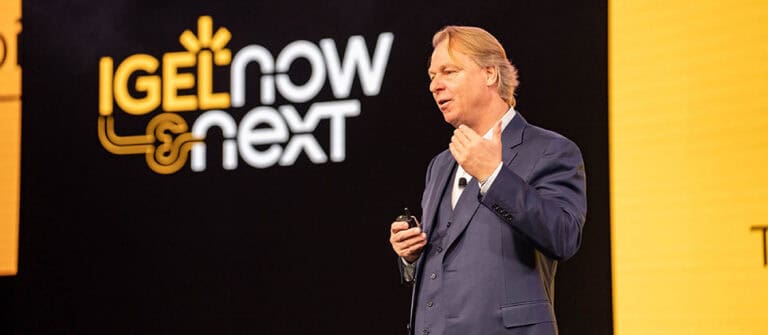
Former Chief of Cyber Command, General (ret.) Paul Nakasone’s message on the main stage made it clear for all IT organizations regardless of industry. Organizations should not ask if they will be attacked. They should assume they will and decide how they will operate when it happens.
As organizations prepare for cyber attacks and implement adaptive access, defining who gets what experience under what conditions, they build a resilient endpoint. And business continuity is the best way to win against outside forces.
Taken together with the ecosystem integrations that ensure identity, network, and application controls, the endpoint plane becomes a more complete model for resilience. One that does not rely on perfect prevention or rapid recovery alone, but on the ability to keep the business moving while conditions evolve.
What’s next? Join us at an upcoming summit
IGEL Now & Next Miami 2026 showed where endpoint strategy is heading, but now it’s time to see how that direction plays out in real environments, with real constraints, and alongside peers facing the same decisions.
That is exactly what the IGEL Now & Next Workspace & Endpoint Security Summits are designed to do.
These one-day events take the spirit of Now & Next to a local city near you, where transformation is already underway. They create space for deeper conversations as to how organizations are applying these ideas to support Zero Trust, reduce risk, and modernize digital workspaces without disrupting the business.
You’ll hear directly from industry leaders shaping the direction of endpoint security. You’ll see how enterprises are putting these strategies into practice. You’ll engage in discussions that move beyond theory into execution. And just as importantly, you’ll connect with peers who are working through the same challenges in your region.
Join us in a city near you and take part in the next phase of the conversation around secure digital workspaces.
IGEL Now & Next 2026 session content is available on demand. To learn more about these and other announcements from IGEL Now & Next 2026, visit igel.com/nowandnext2026.
Related Posts