IGEL Blog
Why IT and OT Convergence Requires Stronger Workforce Authentication
Manufacturers can no longer secure devices alone. Trusted access requires both a secure endpoint and verified operator identity.
Manufacturing has a new access problem.
As IT and operational technology (OT) converge, factory-floor endpoints, engineering workstations, operator terminals, digital signage, warehouse devices, and other systems increasingly connect people to critical operational applications. IT teams are taking on more responsibility for these endpoints, bringing modern enterprise management and security practices into environments that have traditionally been managed separately—while still meeting strict uptime, safety, and compliance requirements.
That convergence creates an enormous opportunity. It also changes the security equation.
It is no longer enough to ask, “Can I trust this endpoint?” Manufacturers increasingly need to ask a second question: “Can I trust the identity of the person using it?”
In modern manufacturing environments, trusted access requires both: a secure, governed endpoint and strong workforce authentication that verifies who is requesting access.
Manufacturing is experiencing IT/OT convergence
Historically, operational technology was managed separately from enterprise IT. Today, the boundary is becoming less distinct as IT teams support factory-floor endpoints, engineering workstations, operator terminals, digital signage, and other systems that provide access to operational applications and critical infrastructure environments.
IGEL addresses this shift as “IT for OT”: extending modern IT management and security practices into operational environments through the IGEL Adaptive Secure Endpoint Platform™, with IGEL OS™ providing an immutable, read‑only operating system foundation and the IGEL Universal Management Suite™ (UMS) delivering centralized endpoint configuration and policy management.
The goal is not to replace the manufacturer’s existing OT security architecture. It is to provide a trusted and governed endpoint layer that fits alongside existing identity, application, network, and operational security controls.
More connectivity creates more identity challenges
As manufacturers digitize operations, more people interact with manufacturing execution systems (MES), supervisory control and data acquisition (SCADA) systems, engineering applications, quality management systems, warehouse platforms and logistics systems.
That changes the access question. Securing the device remains essential, but manufacturers also need to know who is accessing operational systems, when that access occurs, and how activity can be traced to an individual and governed by role‑appropriate policies.
Shared environments make this difficult. Multiple operators may use the same workstation during a shift. Engineers move between systems. Contractors and temporary personnel may require time‑bound, role‑specific access. Generic accounts, shared credentials, and ad hoc access practices can make it difficult to attribute individual activity, creating gaps in accountability, auditability, and incident investigation.
As digital transformation expands the number of connected systems and users, manufacturers must also address how worker identity is established and verified across shared operational environments.
Why workforce authentication becomes critical
A well-managed endpoint does not establish operator identity on its own. Similarly, authenticating an operator does not establish the integrity of the endpoint being used. Manufacturers need both controls working together.
Strong, user-specific workforce authentication helps replace anonymous or shared access patterns with access consistently associated with a verified individual. As manufacturers modernize access strategies, many are extending trusted physical access credentials into IT and OT environments. Badge-based authentication, enabled by solutions such as HID® OMNIKEY® readers, makes that transition practical in operational environments where users need to move quickly between shared workstations without adding unnecessary friction.
This is especially important in manufacturing environments where organizations must be able to identify who accessed a system, who performed a specific action, and who approved critical processes. Strong workforce authentication helps create a reliable record of user activity by linking access events and actions to verified individuals. This visibility can support quality management initiatives, regulatory compliance, audit readiness, and incident investigations while reducing reliance on shared credentials and anonymous access.
Secure endpoint + trusted operator identity
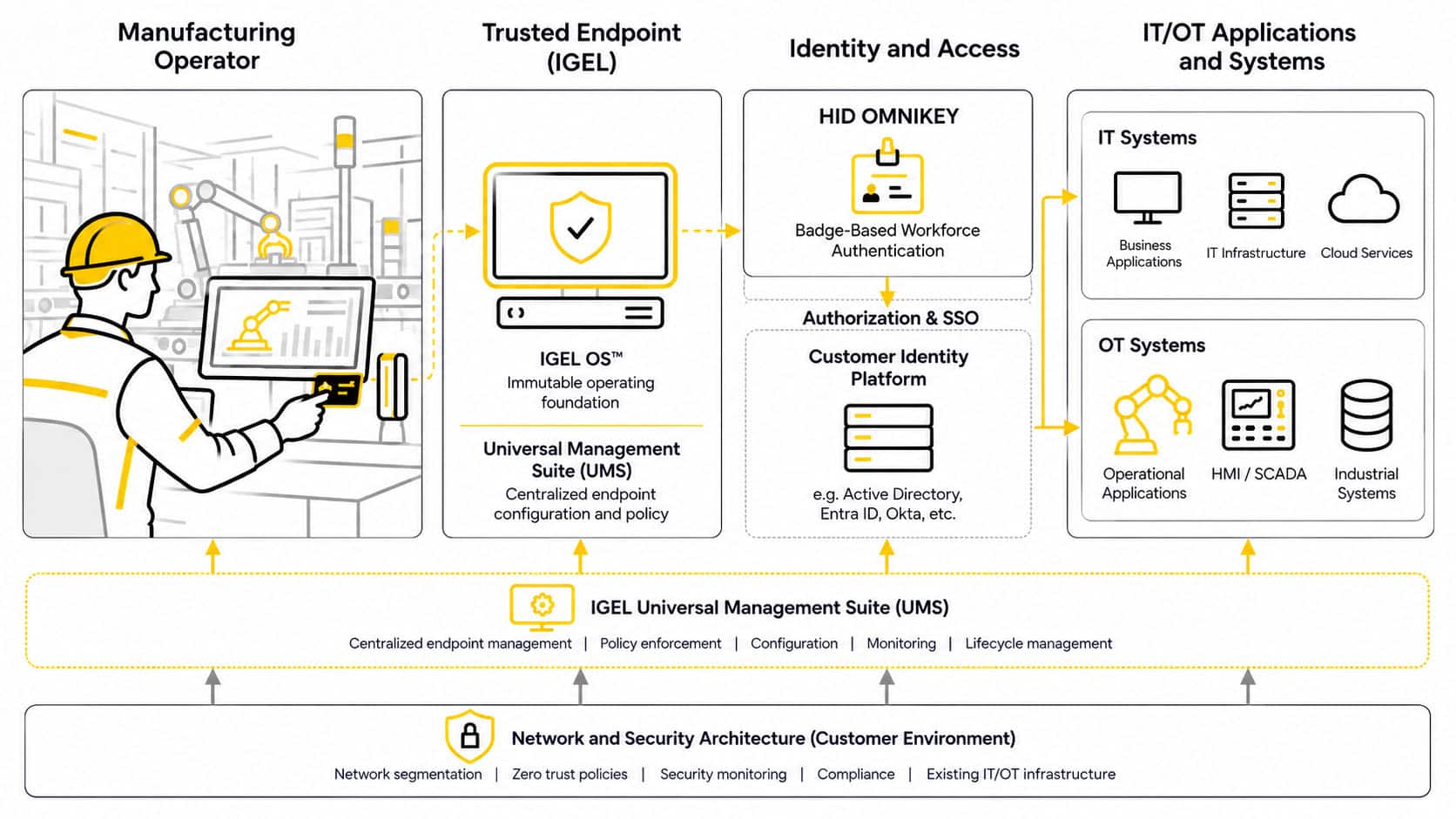
This is where the complementary value of IGEL and HID comes together: IGEL establishes and governs the endpoint foundation, while HID strengthens workforce authentication at the point of access.
IGEL: establish trust in the endpoint
IGEL OS™ provides an immutable, read‑only operating system foundation designed to reduce endpoint attack surface. UMS gives IT centralized control over endpoint configuration and policy across distributed operational environments, including shared devices. Together, as part of the IGEL Adaptive Secure Endpoint Platform™, these capabilities provide a trusted endpoint layer for access to MES, SCADA, and other critical systems while supporting persona‑appropriate, centrally managed control.
HID OMNIKEY: establish trusted operator identity
HID OMNIKEY readers complement this foundation by enabling highly secure, badge-based workforce authentication for operators, engineers, contractors, and other authorized personnel. Using credential technologies already trusted by many manufacturers for physical access, HID OMNIKEY helps extend trusted identity into digital workflows and shared operational environments.
By linking access events to verified individuals, HID OMNIKEY strengthens accountability across manufacturing operations and supports traceability requirements that are critical for audits, investigations, quality processes, and regulatory compliance. Organizations gain greater visibility into who accessed systems, when access occurred, and how activities can be attributed throughout operational workflows.
Because HID OMNIKEY leverages familiar badge credentials, manufacturers can improve security without introducing unnecessary complexity for users operating in fast-paced production environments.
Together: close the loop between device trust and user trust
The distinction matters. Device security does not establish operator identity, and operator authentication does not establish endpoint integrity. Treating them as separate but coordinated controls aligns with modern zero‑trust principles and creates a stronger model for converged IT/OT access to MES, SCADA, engineering tools, and other cloud or virtualized applications.
In that model, IGEL OS™ establishes the immutable endpoint foundation, UMS centrally governs the endpoint, and HID OMNIKEY readers verify the individual requesting access. The customer’s existing identity and SSO platform, together with their operational applications, then determine what that verified user is authorized to access.
Together, IGEL and HID OMNIKEY help manufacturers address both sides of the trust equation. IGEL ensures that the endpoint accessing operational applications is secure, governed, and centrally managed, while HID OMNIKEY ensures that access is tied to a verified individual. This combination helps organizations improve security posture while increasing operational accountability and end-to-end traceability across manufacturing workflows.
Outcome: Trusted IT/OT Access
Manufacturers need confidence in both sides of every access event: the machine and the person at the keyboard. As IT-managed endpoints increasingly serve as the front door to operational systems, secure endpoints and strong workforce authentication are foundational to resilient manufacturing operations.
By pairing centrally managed, immutable endpoints with badge-based workforce authentication, IGEL and HID OMNIKEY enable manufacturers to unify device and user trust across modern manufacturing environments, strengthening trusted IT/OT access while preserving existing identity, application, network, and OT security investments.
Closing takeaway: IGEL secures the endpoint. HID OMNIKEY establishes trusted operator identity. Together, they enable trusted access across modern manufacturing environments.
Call to Action
IGEL and HID OMNIKEY readers help manufacturers bridge IT and OT with secure endpoints, trusted workforce authentication, stronger accountability, and end-to-end traceability across operational workflows.
Learn more about The Adaptive Secure Endpoint Platform™ for Manufacturing here. Learn more about HID OMNIKEY readers here.
Posted in Cybersecurity, IT/OT
Related Posts