
IGEL Blog
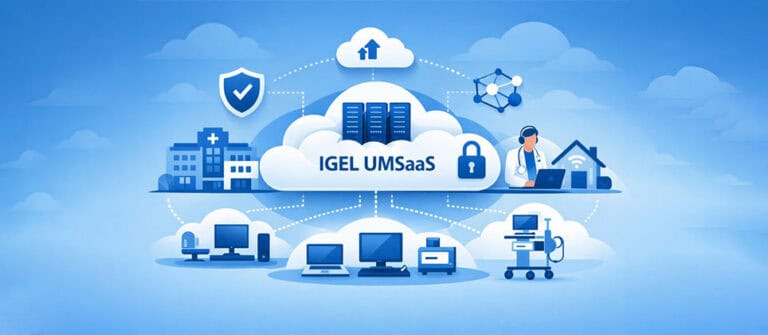
Why Cloud-Managed Endpoint Management Makes Sense for the NHS
Across the NHS, digital teams are under pressure to modernise infrastructure while staying aligned with national architecture principles around cloud adoption, sustainability, security, and user-centred design. Endpoint management might not always be the headline topic, but it quietly underpins almost every clinical workflow.
As more NHS applications move toward VDI, SaaS, and cloud-hosted platforms, the way endpoints are managed needs to evolve too.
That’s where IGEL Universal Management Suite as a Service (UMSaaS) fits, not as a radical reinvention, but as a practical step that aligns well with the direction NHS architecture has already set.
Cloud first, without the operational overhead
NHS guidance is clear: services should move to the public cloud unless there is a compelling reason not to. Traditionally, endpoint management platforms have required on-premises servers, databases, backups, patching, and lifecycle planning, all of which add operational risk and cost.
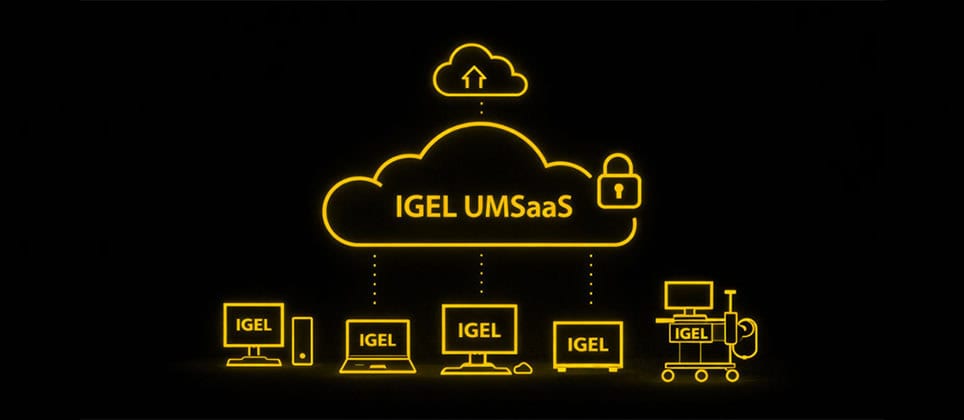
UMSaaS significantly reduces that burden. The management plane is cloud-hosted and maintained by IGEL, allowing NHS teams to focus less on infrastructure upkeep and more on service outcomes. For CIOs and CTOs, this often translates into improved resilience, predictable scaling, and fewer local failure points.
Internet-first and browser-based by design
Modern NHS services are expected to be accessible over the public internet and delivered through standard browsers. IGEL UMSaaS aligns naturally with this approach.
The management console is browser-based and accessible securely from anywhere, without reliance on private networks or legacy VPN models. Endpoints communicate using modern, encrypted protocols, supporting management across hospitals, community sites, and remote or home-based workers.
This isn’t about convenience alone, it reflects a broader shift toward simpler, more flexible operating models that scale across integrated care environments.
Security and sustainability built in
While IGEL UMSaaS does not store patient or user PII, it still meets NHS expectations around cyber security and sovereignty. The platform is UK-hosted, continuously patched, monitored, and designed to reduce attack surface by removing on-prem management servers altogether.
There’s also a sustainability angle that’s increasingly hard to ignore. Fewer local servers mean lower power consumption, reduced hardware refresh cycles, and less embodied carbon, all directly supporting NHS Net Zero commitments.
Designed around how NHS teams actually work
Endpoint management should make life easier, not add friction. IGEL UMSaaS supports common NHS clinical and digital workplace scenarios, including integration with Imprivata, Citrix, Omnissa, and Microsoft AVD or Windows 365 environments.
For IT teams, this means faster onboarding, simpler profile management, and consistent rollout across wards, clinics, and Trust sites. For clinicians, it contributes to a more reliable, responsive workspace, even if they never see the platform behind it.
A pragmatic step forward
IGEL UMSaaS isn’t about chasing cloud for its own sake. It’s about aligning endpoint management with the same architectural principles already guiding NHS digital services: cloud first, internet first, secure by default, and sustainable by design.
For NHS digital leaders, it offers a low-risk, practical way to modernise a critical layer of the clinical IT estate, quietly, sensibly, and in step with national direction.
Call to Action
If you’re exploring cloud-first strategies for VDI, Windows 365, or clinical endpoints, it’s worth considering whether your endpoint management approach is evolving at the same pace.
Learn about the Importance of Endpoint Security in Healthcare
Posted in Cybersecurity, IT/OT