IGEL Blog
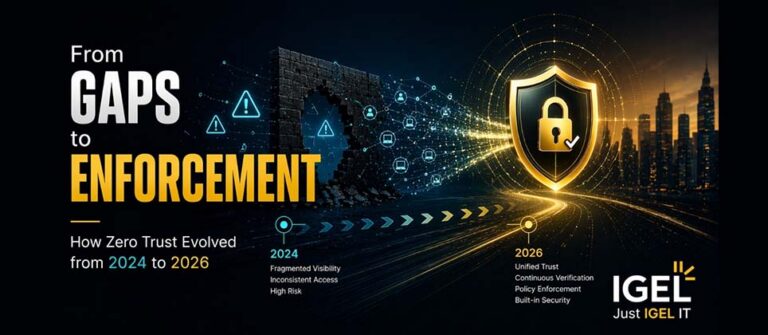
From Gaps to Enforcement: How Zero Trust Evolved from 2024 to 2026
Across government, financial services, and healthcare, one idea is now widely accepted: Zero Trust is not a project; it’s a journey.
Most enterprises understand that reaching full Zero Trust maturity takes years and is not a one and done process. In most cases, identity modernization, network segmentation, endpoint controls, and policy orchestration don’t happen overnight.
That reality hasn’t changed. What has changed between 2024 and 2026 is something far more important: Organizations no longer need to wait years to materially reduce risk. The difference isn’t strategy; it’s enforcement.
The Reality in 2024: Strategy Without Enforcement
In 2024, Zero Trust assessments across large enterprises revealed a consistent pattern.
Most organizations had already made significant investments in identity platforms, MFA, cloud and network security tools, and centralized logging and analytics. These capabilities formed a strong strategic foundation, yet outcomes continued to lag expectations.
Assessments repeatedly identified the same issues:
- Gaps in policy enforcement at the endpoint
- Security controls operating in silos
- Low confidence in endpoint integrity
This wasn’t a tooling problem but an enforcement problem.
Industry research, including the Microsoft / Ivanti Zero Trust Progress Report, consistently shows that compromised endpoints remain one of the most common initial footholds in breaches, even in environments with Zero Trust strategies in place. Policies existed, but endpoints remained the weakest link.
The Shift by 2026: Fewer Gaps, Real Control
By 2026, leading organizations look meaningfully different, even when their overall Zero Trust roadmap remains unfinished. What has changed? Enforcement gaps are significantly reduced, identity, network, and security tools are tightly integrated, policies are consistently enforced at the endpoint, and security teams have higher confidence in telemetry and controls. Importantly, this progress did not require wholesale replacement of infrastructure. The strategy stayed largely the same, but the ability to enforce it improved.
Why Enforcement Changes Everything
Most Zero Trust initiatives stall for a simple reason: policies exist, but enforcement can be bypassed. Traditional, general‑purpose endpoints remain vulnerable to malware persistence, unauthorized code execution, credential theft, and lateral movement, concentrating risk at the endpoint.
Industry guidance from CISA, the FBI, and MITRE consistently shows that lateral movement is a defining phase in successful ransomware attacks, typically originating from compromised endpoints. Once persistence is established, policy intent becomes irrelevant. Zero Trust fails when enforcement is optional.
Closing the Gap: The Endpoint as an Enforcement Layer
IGEL addresses this enforcement gap by design. With IGEL Adaptive Secure Endpoint Platform™ and the Preventative Security Model™:
- Immutable endpoint OS cannot execute unauthorized code
- Local persistence is eliminated and policies are enforced consistently on all endpoints
- Users cannot bypass access controls or install unauthorized software applications
- All activity flows through approved, inspectable paths to maintain compliance
This shifts the endpoint from a liability to something many environments lack: a deterministic enforcement layer. For security leaders, enforcement is what turns Zero Trust from a concept into an operational reality.
Meaningful Progress in months, not in years
Organizations that adopted immutable endpoint OS platforms in 2024 saw measurable improvements by 2026, including:
- Material reduction in exploitable endpoint risk
- Elimination of common persistence mechanisms
- Fewer lateral movement paths
This aligns with broader industry outcomes. Organizations that reduced endpoint persistence saw up to 60% faster incident containment according to PurpleSec’s recent Cybersecurity Statistics report as well as seeing a significant reduction in false positives & more effective automated response. Not because Zero Trust was “finished,” but because it was consistently enforced.
Integration, Not Replacement
One of the clearest lessons from the past two years is this: accelerating Zero Trust does not require replacing your security stack.
IGEL integrates directly with existing enterprise investments, including:
- Identity providers such as Microsoft Entra ID and Okta
- Network access control platforms like Cisco ISE and Forescout
- ZTNA solutions including Zscaler and Netskope
- Security analytics and SIEM platforms such as Microsoft Sentinel and Splunk
This approach allows organizations to preserve prior investments, improve interoperability across security controls, and accelerate Zero Trust outcomes without disruption. The architecture evolves while enforcement becomes stronger and more consistent.
Better Enforcement Produces Better Data
As Zero Trust matures, security decisions increasingly rely on analytics, automation, and AI‑driven response. But these systems are only as effective as the data they consume. Traditional endpoints often produce unreliable telemetry due to compromise, configuration drift, or unauthorized execution.
IGEL’s Adaptive Secure Endpoint Platform™ continually operates in a known good state and prevents unauthorized activity by design. The result is:
- Higher confidence telemetry
- Fewer false positives
- More reliable automated decisions
For CISOs, this directly improves SOC efficiency and reduces mean time to detect and respond.
Extending Zero Trust to the Endpoint Execution Plane
The Trusted Macro Secure Enclave™ (TMSE) is IGEL’s policy governance model that operationalizes Zero Trust at the endpoint. Where the IGEL Preventative Security Model ensures the endpoint is trustworthy by design, TMSE defines how that trusted endpoint participates within a Zero Trust architecture.
In simple terms, Zero Trust often focuses on identity, network, and application policy. TMSE extends that model to the endpoint execution plane, turning it into an active enforcement point rather than a passive access device.
Built on the three-plane architecture of The Adaptive Secure Endpoint Platform™:
- The secure endpoint OS provides a known-good execution state
- Universal Management Suite (UMS) enforces real-time policy as the control plane
- The App Portal ensures only validated applications are delivered as the data plane
This creates a continuously verified trust boundary where access is not assumed but proven and enforced at the endpoint itself.
Why it matters for Zero Trust
TMSE reframes the endpoint from a potential risk to a deterministic control point in Zero Trust:
- Continuous verification: Trust is not granted once. Endpoint state, user context, and policy alignment are continuously validated
- Policy enforcement at the edge: Decisions from identity providers or SSE platforms are enforced directly where work happens
- Segmentation by design: Each endpoint operates within its own governed boundary, limiting blast radius and lateral movement
- Trusted workload delivery: Only attested applications and services are allowed to execute, reducing exposure to unknown software
The result is a more complete Zero Trust model. Identity and network controls define intent, while TMSE ensures that intent is enforced at the point of execution.
Final Thought: The New Measure of Zero Trust Progress
Zero Trust still takes time. That hasn’t changed. What has changed is how progress is measured. Organizations advancing fastest aren’t waiting for a perfect end state. They are focused on strengthening enforcement early and building on it over time, turning Zero Trust from strategy into sustained risk reduction.
The evolution from 2024 to 2026 shows what’s possible when enforcement becomes real, consistent, and measurable. The question now isn’t whether Zero Trust is the right strategy; it’s where your security posture will be two years from today.
Next steps
If you’re evaluating how to accelerate Zero Trust outcomes without disruption, contact an IGEL representative to discuss your Zero Trust goals and learn how enforceable endpoint controls can help you move faster and with confidence. Let’s discuss your Zero Trust goals and learn how enforceable endpoint controls can help you move faster and with confidence.
Posted in Zero Trust, Cybersecurity
Related Posts